Skip to content
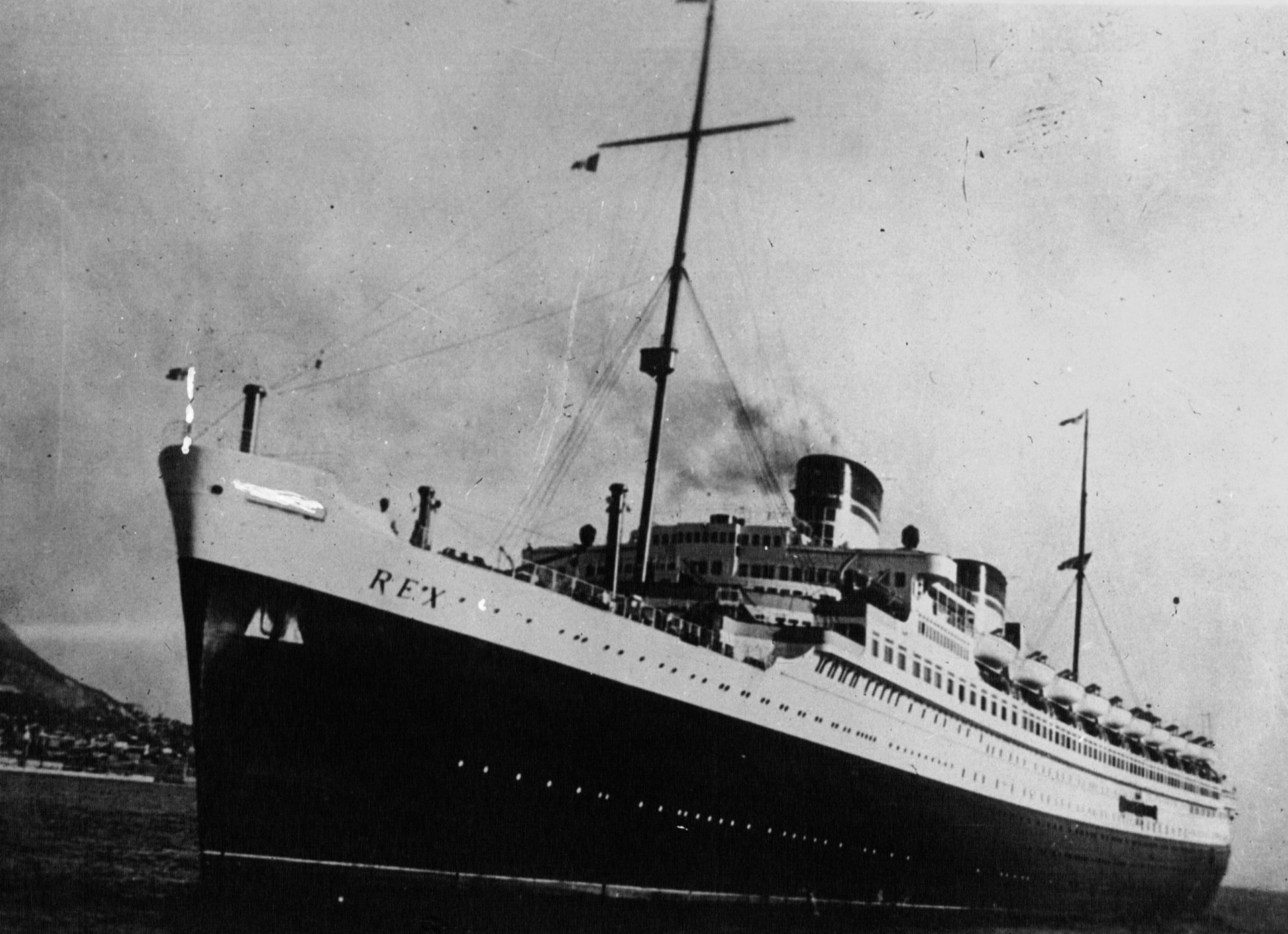
1932 photograph: the Italian liner Rex under way, seen three-quarters on from the bow, smoke from her funnels, hills on the shore behind.

There are stories that deserve to go on sailing

Transatlantic Heritage

The ships that carried them over

Six liners, and the crossings they made out of Genoa, Barcelona, Liverpool and Bremerhaven. Each one carries its name, its years and its route on the chest.

6 ships 1907–1960 5 where the artwork and the sources disagree

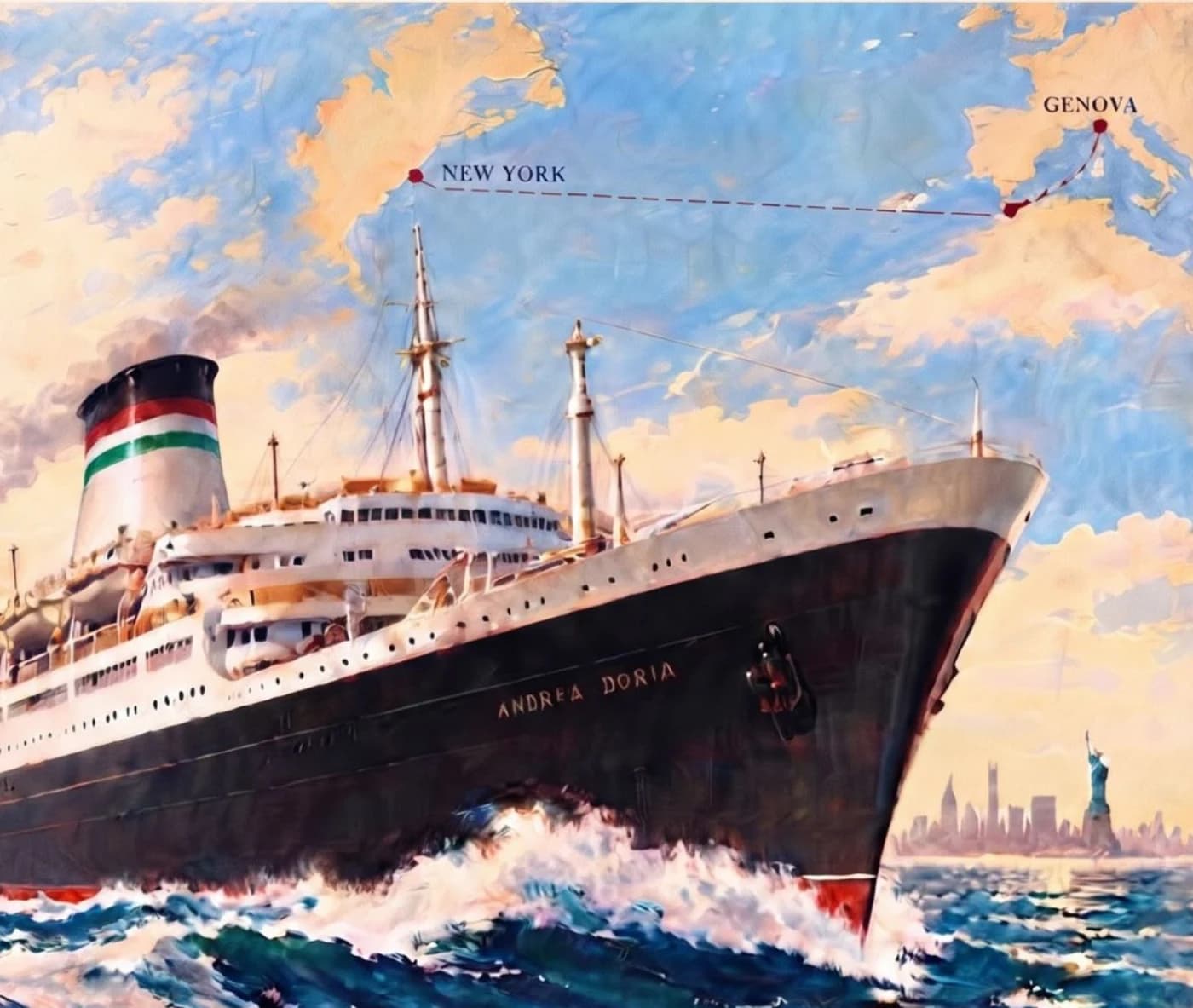
Painted illustration: the liner Andrea Doria under way with her funnel in the Italian colours, the New York skyline and the Statue of Liberty low on the horizon; at the top a dotted line links Genoa to New York across a map.
Transatlantic Heritage Illustration, not a photograph Andrea Doria: the emblem of the route, not one of the six garments [to be provided: who made it, or which tool generated it, and under what licence]
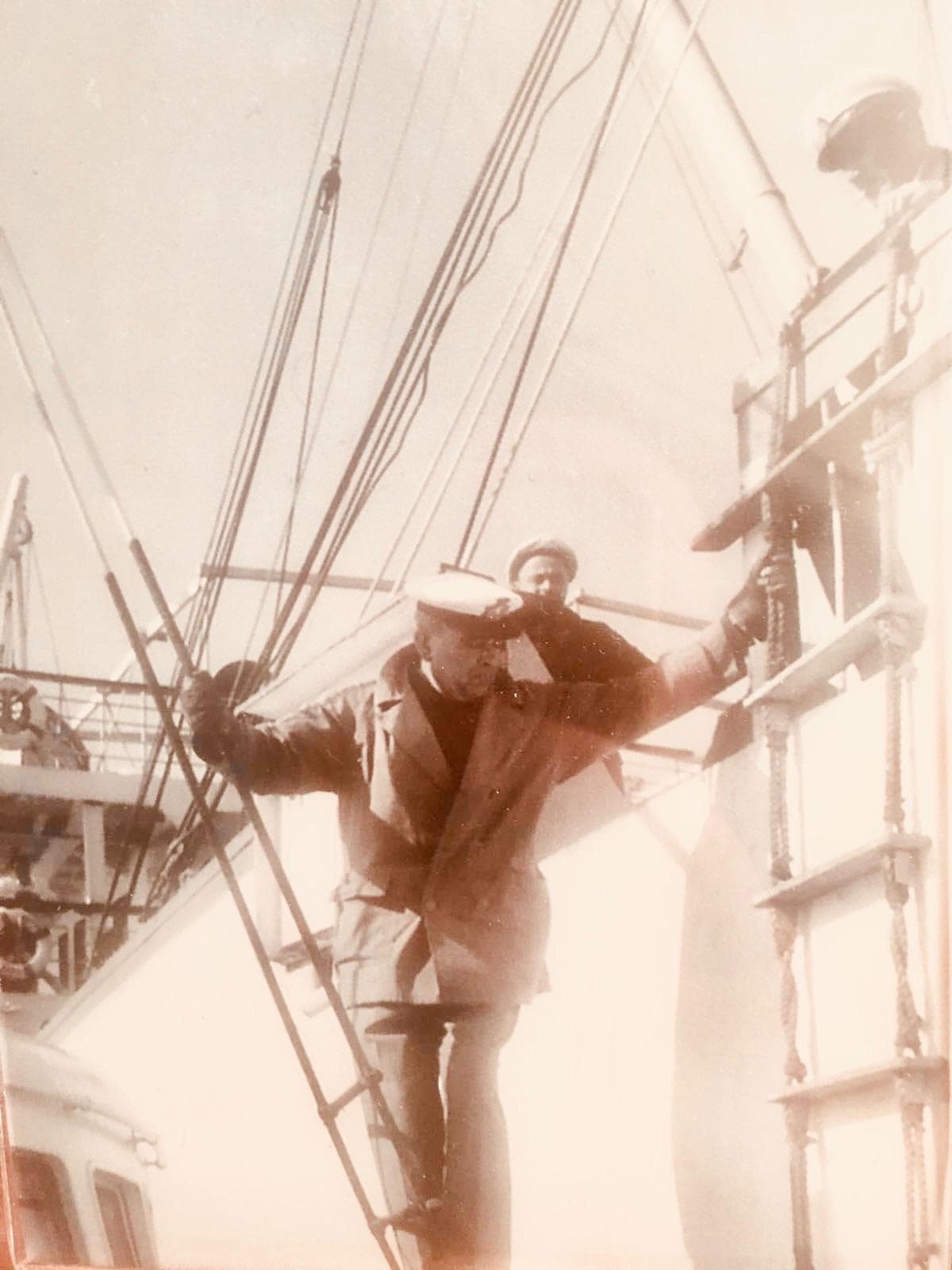
Period photograph, sepia toned: a uniformed pilot in a peaked cap climbs a rope ladder up a ship's side; a second man above him.
Family archive Stefano Stagnaro's maternal grandfather identified by the family as Giovanni Raimondi, pilot and former chief pilot of the port of Genoa [to be confirmed] [to be provided: year] [to be provided: port]

Storie di mare

The memory of pilotage

This space is given to the historical memory of pilotage: the pilots, the destinies, the people who made the trade a calling. Photographs, papers and testimony, each published with its source beside it.

Memory is the course we steer by.

Storie di mare · 01

By Stefano Stagnaro

Giovanni Raimondi and the Grazia

A ship’s name, a promise for a lifetime

There are names that keep a story inside them. My mother’s name, Grazia, keeps a ship, a sinking and her father’s promise: Captain Giovanni Raimondi, my grandfather, a pilot and formerly chief pilot of the port of Genoa.

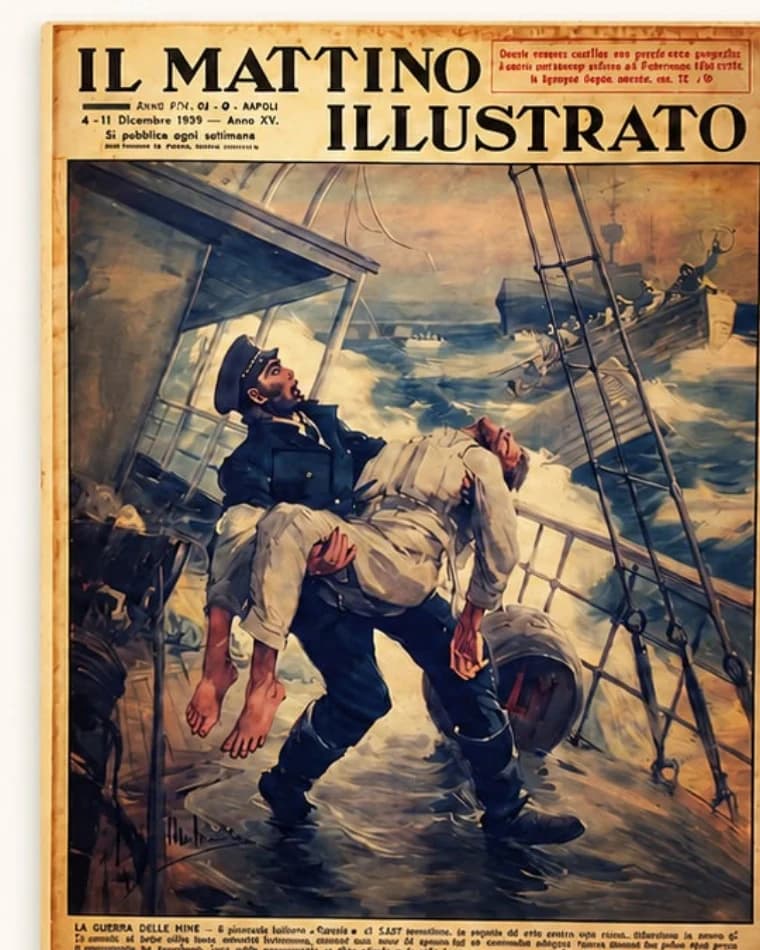
Cover of Il Mattino Illustrato, 4-11 December 1939: a painted plate showing a ship's officer carrying an injured barefoot sailor in his arms on a listing deck, a lifeboat and the heavy sea behind them.
Il Mattino Illustrato 4-11 December 1939 Family archive

November 1939

The night of the Grazia

  1. 19 November 1939 · from the press

    The steamer Grazia is running from Newcastle to Trieste with a cargo of coal. Italy is not yet at war; the North Sea is already mined.

  2. Minutes before · from the press

    Raimondi finishes a letter home: he is clear of the zone held to be dangerous, the checks remain, then the passage back. The letter never leaves the table in his cabin.

  3. Three explosions · from the press

    The first mine strikes the bow and he orders the crew to the boats. The third tears the stern apart. Heavy sea, freezing water, one of the three boats capsizing at once.

  4. Boschi and Vassallo · from the press

    The radio operator frees a man shut in the storerooms. The chief engineer reaches the British destroyer Gipsy by radio.

  5. The last to leave · family testimony

    My grandfather reaches the seaman Baldassarre Sanfilippo, badly injured, and carries him out. Sanfilippo dies in his arms, before Dover.

  6. The promise · family testimony

    His daughter was to be born within weeks. If he lived he would call her Grazia, after the ship that was lost. When she was born, he kept it.

For me, his grandson and a pilot in turn, telling it keeps a bond that runs across the generations. Every time we say my mother’s name, that story goes on living.

Some names are promises. They are memory. They are the sea.

Stefano Stagnaro · «Alcuni nomi sono promesse. Sono memoria. Sono mare.»

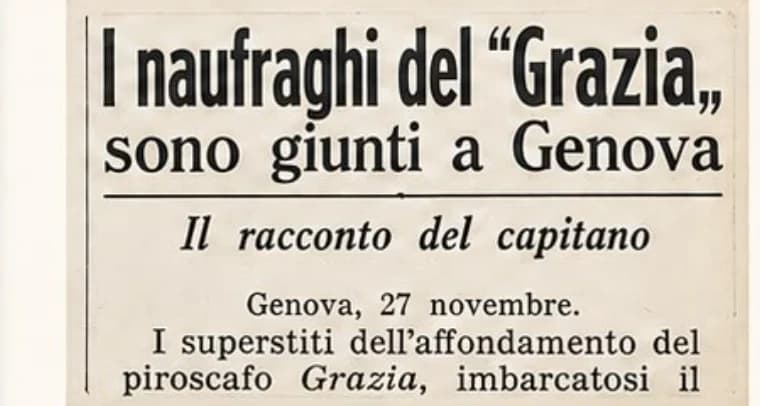
Press: «I naufraghi del Grazia sono giunti a Genova», Genoa, 27 November Il Mattino Illustrato, 4–11 December 1939 [to be provided: the name of the newspaper the cutting is from] the date of the sinking, 19 November 1939 [to be confirmed] [to be provided: a document for the rank: crew list, seaman's book, pilots' register]

Newspaper cutting headed 'I naufraghi del Grazia sono giunti a Genova - Il racconto del capitano', datelined Genoa, 27 November.
Press cutting Genoa, 27 November Family archive [to be provided: the name of the newspaper] the year, 1939, which the cutting itself does not carry [to be confirmed]

The collection

Six ships, six crossings

Each card shows the years and the route as the artwork has them, and what the sources say beside. On 5 of the 6 the two do not agree.

[to be provided: the criterion for these six and not others]

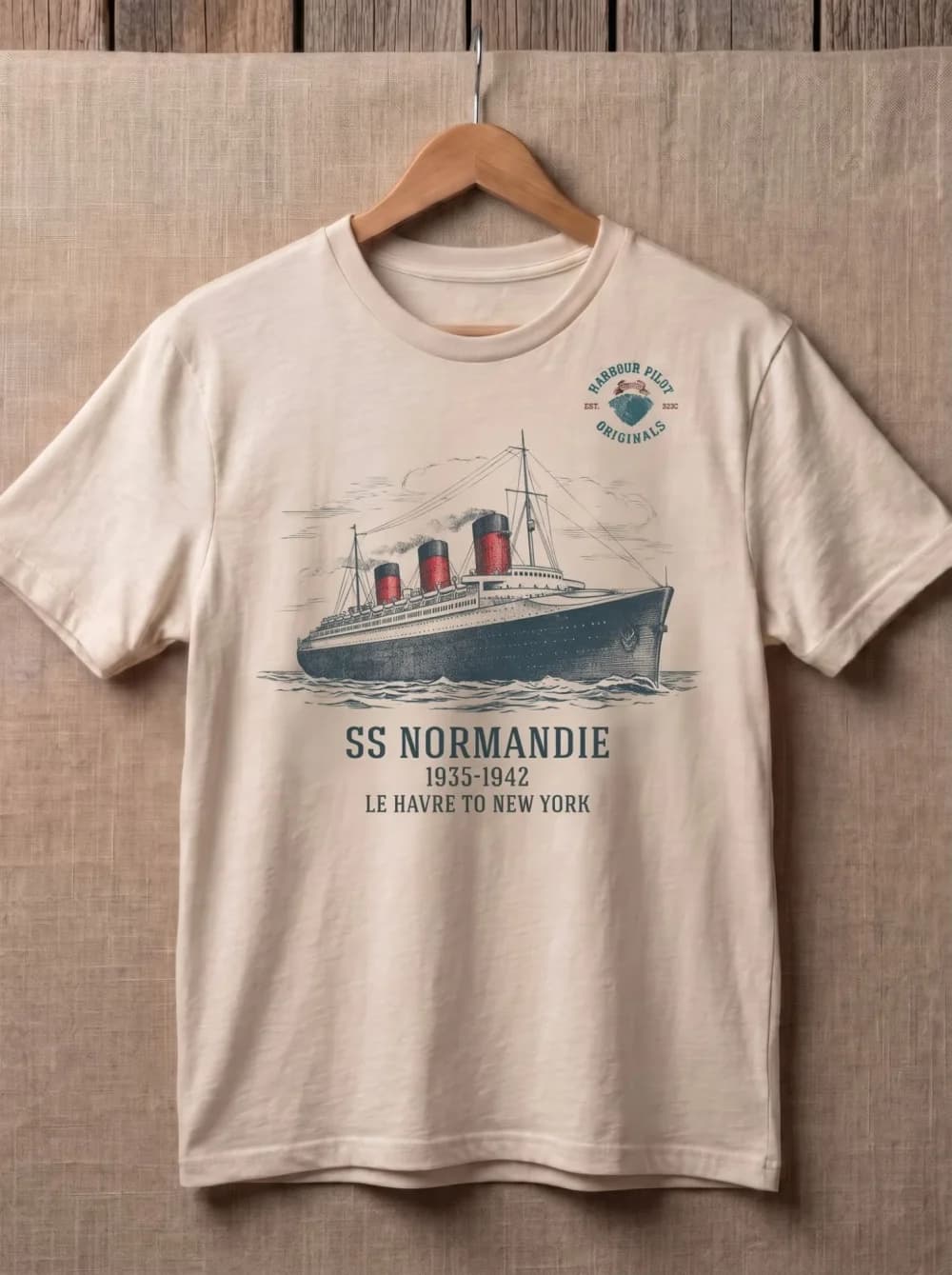
Mock-up: natural cotton T-shirt on a wooden hanger, printed with an engraved-style drawing of the liner Normandie, three red funnels, over the ship's name, years and route.

SS Normandie

On the artwork: 1935-1942 · Le Havre to New York

In service 1935-1939 Lost 1942 the printed range: 1942 is when she was lost, not when the service ended [discrepancy]

What the sources say

Maiden voyage out of Le Havre on 29 May 1935, and the Blue Riband taken on it. She reached New York in August 1939 and never sailed again: held at Pier 88, she caught fire and capsized there in February 1942. Le Havre-Southampton-New York for the whole of her working life. She was the flagship of the French Line, not an emigrant ship.
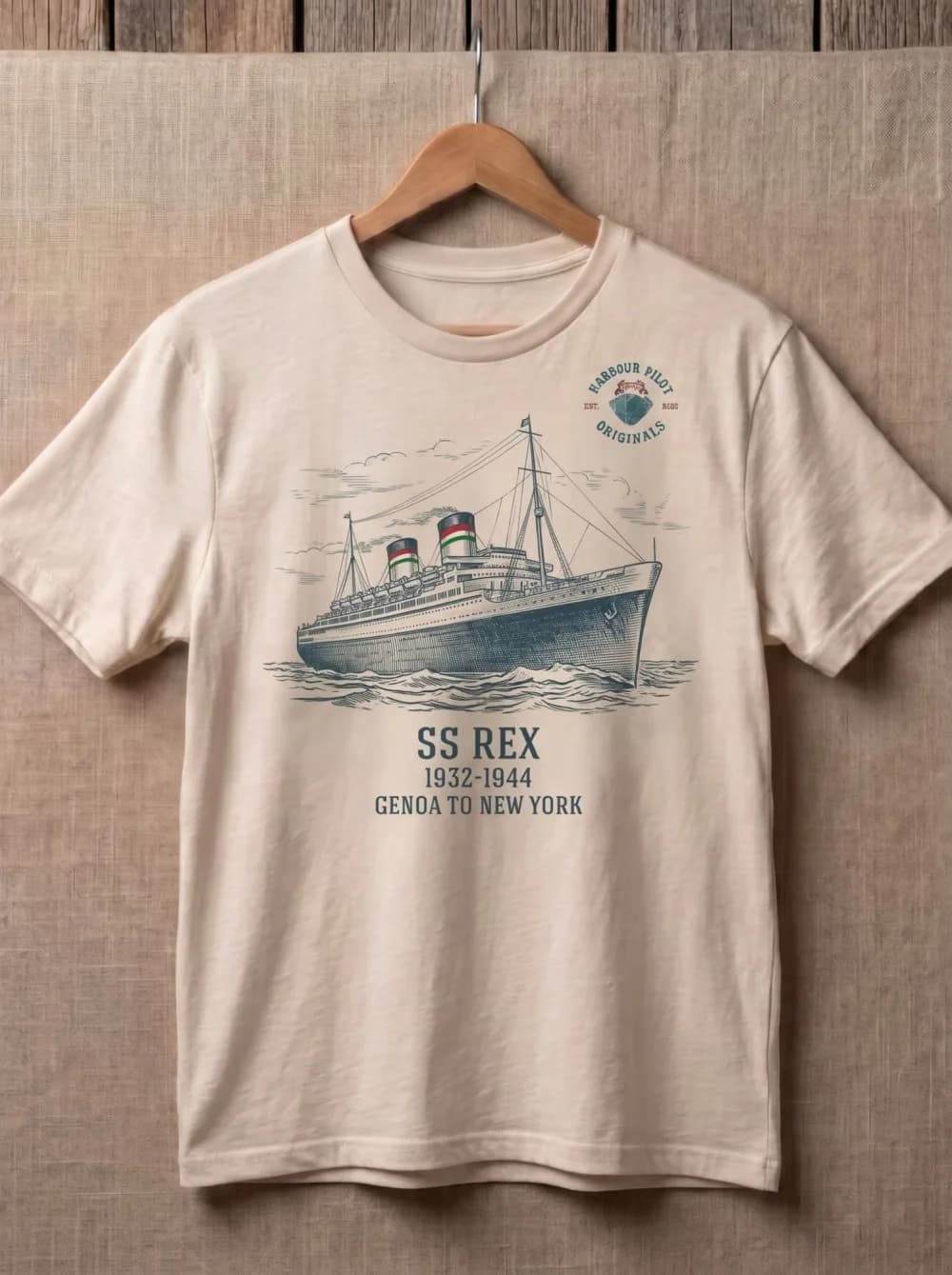
Mock-up: natural cotton T-shirt on a wooden hanger, printed with an engraved-style drawing of the liner Rex, two funnels in the Italian colours, over the ship's name, years and route.

SS Rex

On the artwork: 1932-1944 · Genoa to New York

In service 1932-1940 Lost 1944 the printed range: 1944 is when she was lost, not when the service ended [discrepancy]

What the sources say

Maiden voyage out of Genoa on 27 September 1932. In August 1933 she took the Blue Riband westbound and held it until 1935: the only Italian ship ever to hold it. Her service ended in the spring of 1940; RAF aircraft set her on fire in the bay of Koper on 8 September 1944 and she rolled over in shallow water.

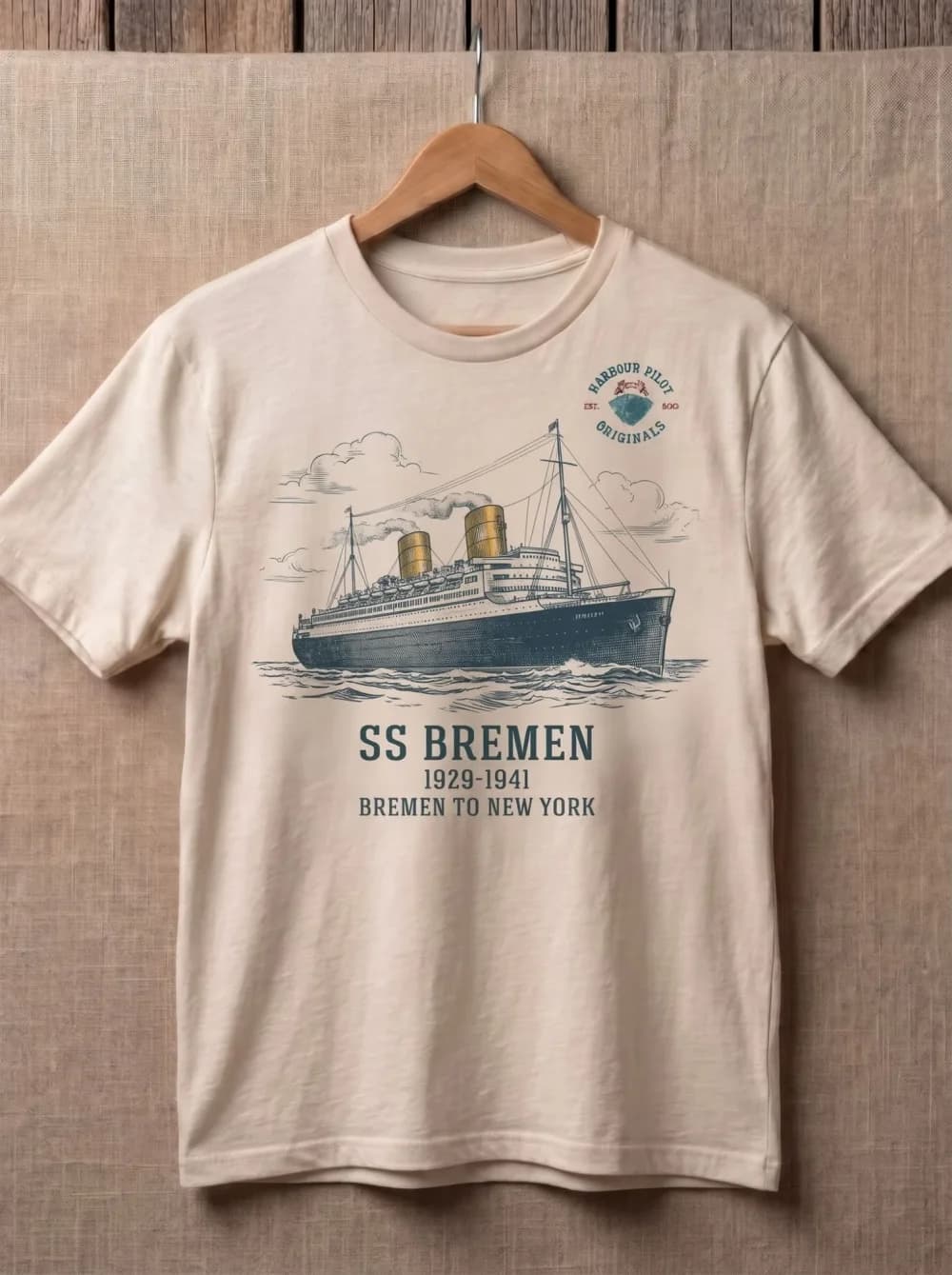
Mock-up: natural cotton T-shirt on a wooden hanger, printed with an engraved-style drawing of the liner Bremen, two low ochre funnels, over the ship's name, years and route.

SS Bremen

On the artwork: 1929-1941 · Bremen to New York

In service 1929-1939 Lost 1941 the printed range: 1941 is when she burnt, not when the service ended [discrepancy] the printed port: the ship sailed from Bremerhaven [discrepancy]

What the sources say

Maiden voyage on 16 July 1929, taking the Blue Riband westbound and eastbound on the same round trip and ending twenty years of Mauretania. Her last commercial crossing was in August 1939; she burnt at her berth on 16 March 1941. She sailed from Bremerhaven, the seaport, not from the city of Bremen.

The collection

04 — 06 of 6

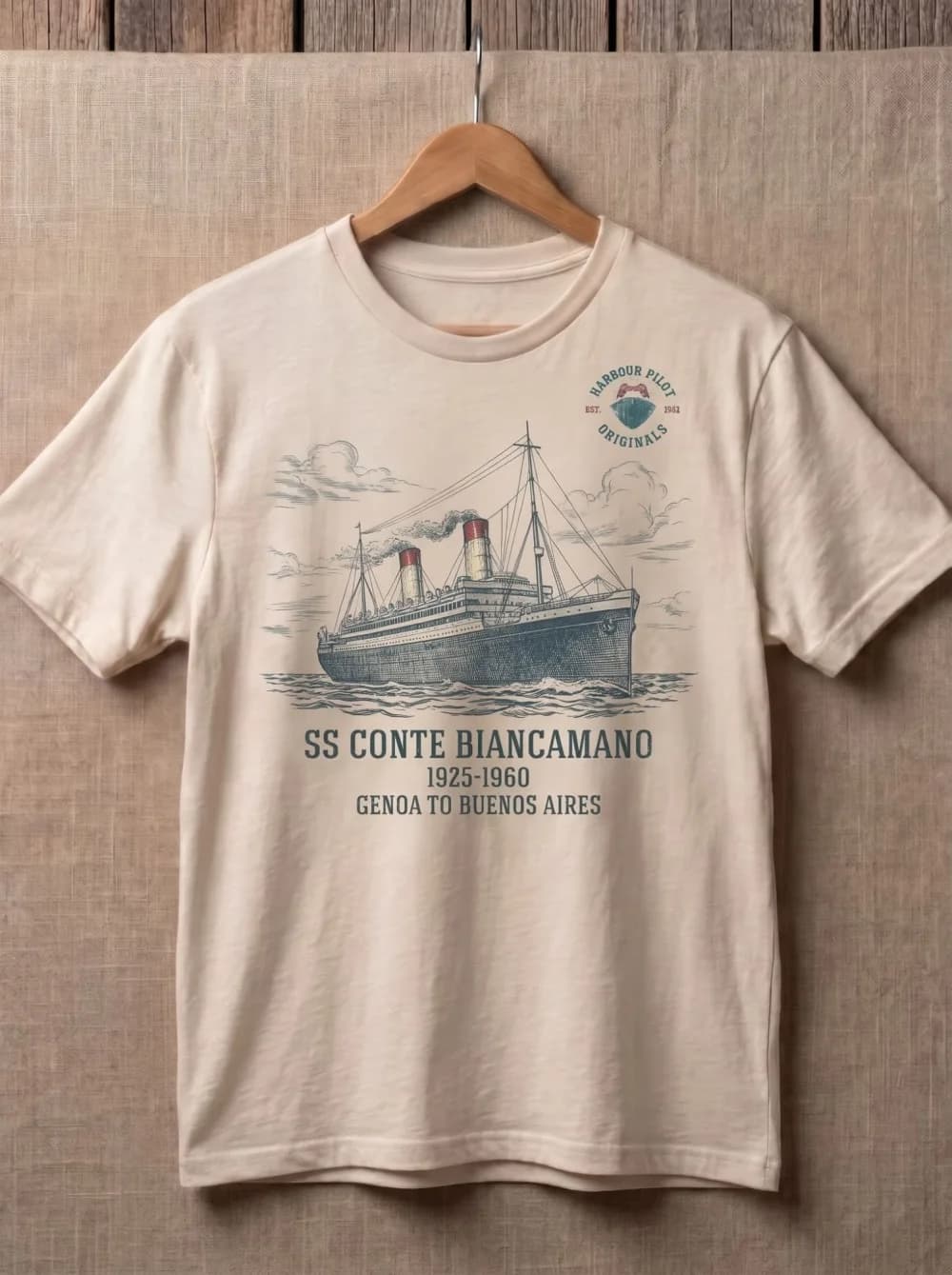
Mock-up: natural cotton T-shirt on a wooden hanger, printed with an engraved-style drawing of the liner Conte Biancamano, two funnels, over the ship's name, years and route.

SS Conte Biancamano

On the artwork: 1925-1960 · Genoa to Buenos Aires

In service 1925-1960, as printed the unbroken range: she was a US troopship from 1941 to 1946 [discrepancy] the printed route: her main run was Genoa-New York [discrepancy]

What the sources say

Maiden voyage Genoa-New York on 20 November 1925; withdrawn in 1960 after 364 crossings. The line was not unbroken: requisitioned by the United States in December 1941, she served as the troopship USS Hermitage until 1946 and came back to Italy in 1947. New York was her main run, from 1925 to 1932 and again from 1950; she worked the River Plate only in limited spells. She and the Reina Victoria Eugenia are the two of the six with a documented emigrant service.

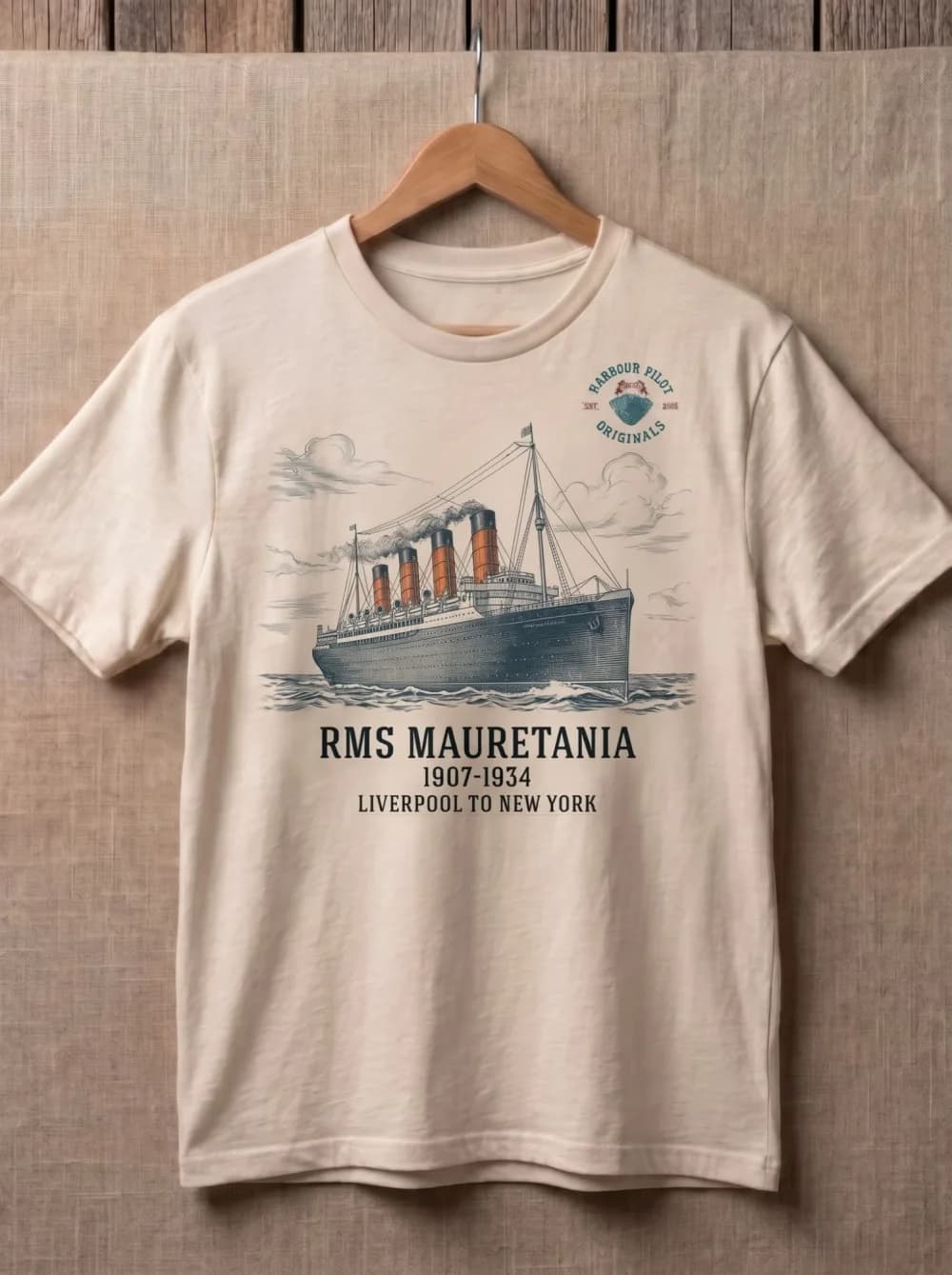
Mock-up: natural cotton T-shirt on a wooden hanger, printed with an engraved-style drawing of the four-funnelled liner Mauretania, over the ship's name, years and route.

RMS Mauretania

On the artwork: 1907-1934 · Liverpool to New York

In service 1907-1934, as printed the printed route: Liverpool holds for 1907-1919 only [discrepancy]

What the sources say

Maiden voyage out of Liverpool on 16 November 1907; withdrawn in September 1934. She held the Blue Riband for some twenty years, until Bremen took it in 1929. Liverpool was her port only until 1919: from September that year she sailed from Southampton.

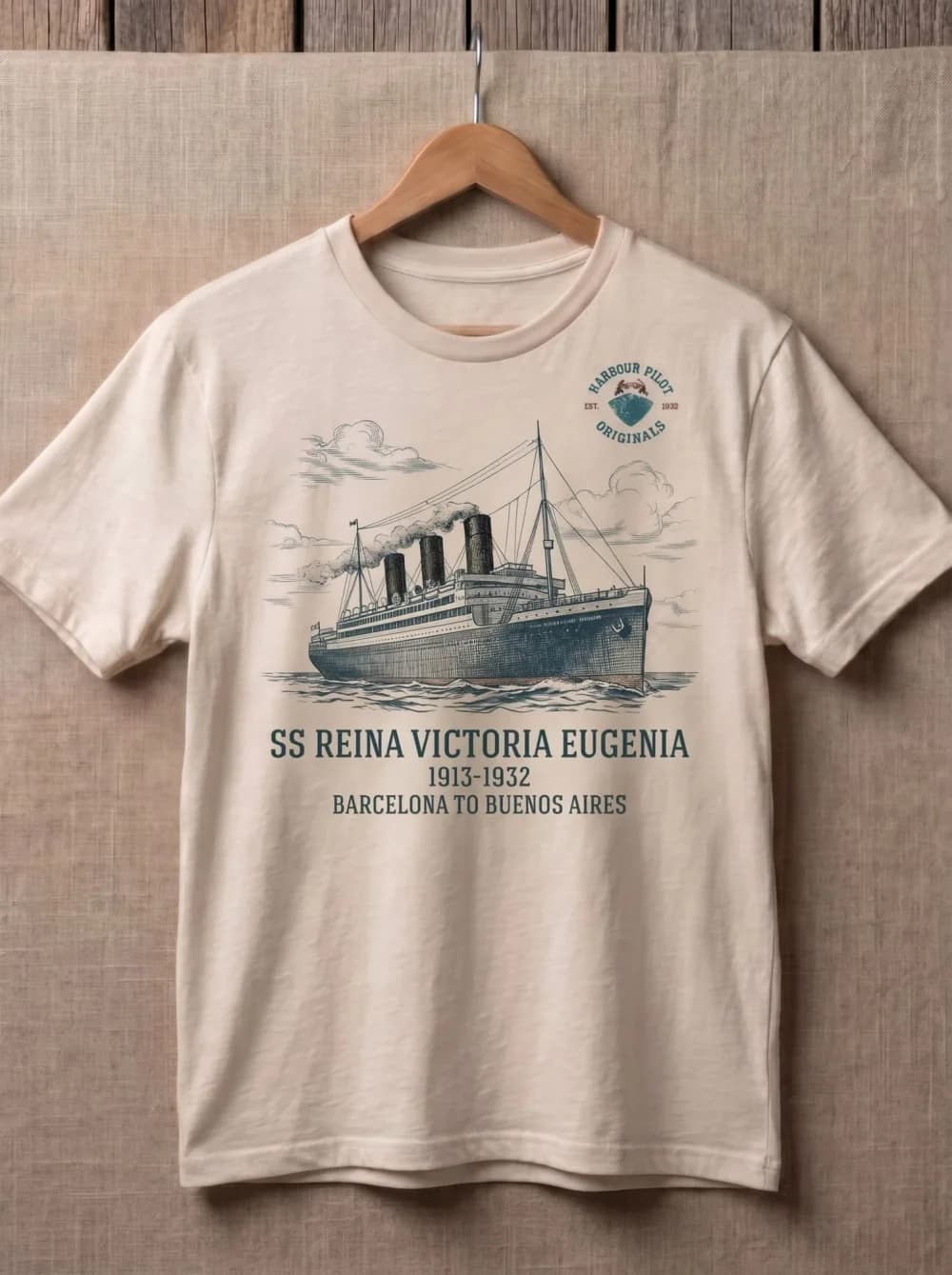
Mock-up: natural cotton T-shirt on a wooden hanger, printed with an engraved-style drawing of the liner Reina Victoria Eugenia, three funnels, over the ship's name, years and route.

SS Reina Victoria Eugenia

On the artwork: 1913-1932 · Barcelona to Buenos Aires

In service 1913-1932, as printed Renamed Argentina in 1931

What the sources say

Maiden voyage Barcelona-Buenos Aires on 12 March 1913, built for the Spain-River Plate run with most of her berths in third class. Renamed Argentina in 1931, laid up in 1932 when the mail subsidy ended, sunk at her moorings in Barcelona by air raid in January 1939.

If you have a photograph, a paper, an account

Crossing papers, seamen’s books, cuttings, photographs with a name on the back. Published with its source beside it, the way this page does — or kept and not published, if you prefer.

[to be provided: the address this material should be sent to]

The rest of the archive →

How the ships were checked

On secondary sources only — encyclopaedic entries and liner histories, no class registers and no company archives. Enough to say that something does not add up; not enough to print.