Sea stories
Classis Ravennas, the fleet of Ravenna
Two thousand years before the pilots of Ravenna, Augustus based an imperial fleet here. The names of its ships survive on the sailors' gravestones.
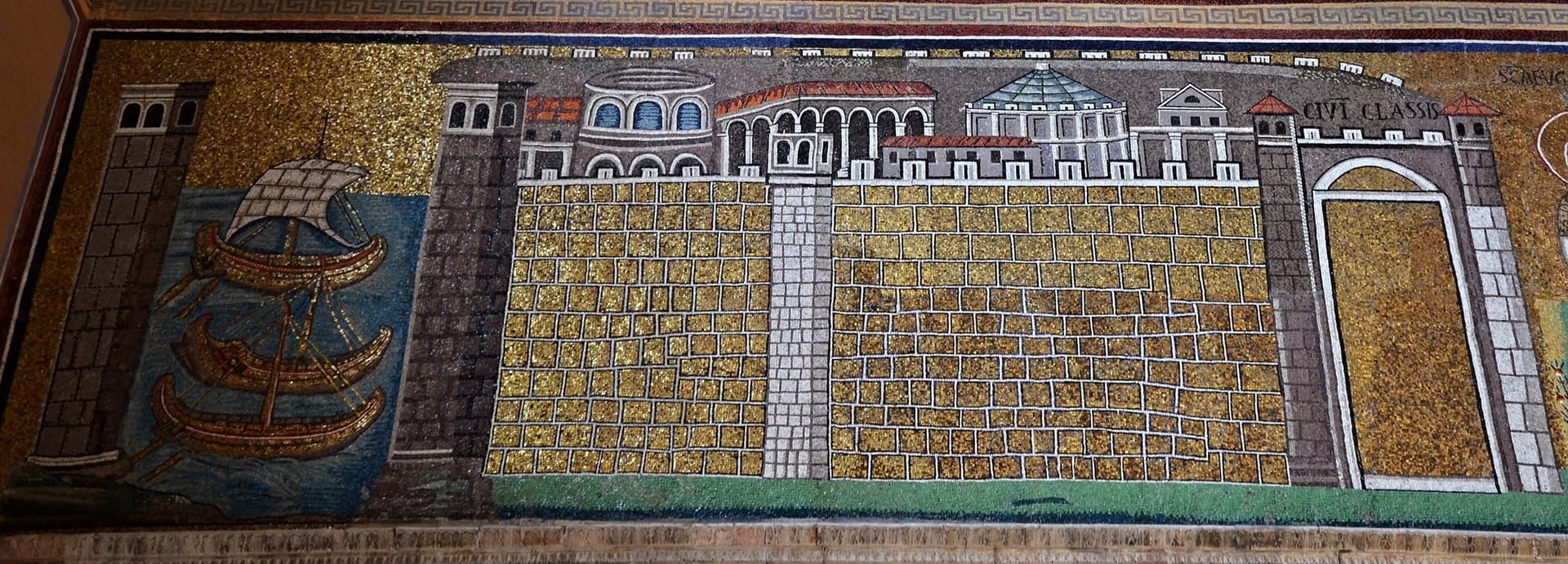
Around 27 BC Augustus based a permanent fleet at Ravenna. It was one of the two fleets that guarded Italy itself — the other lay at Misenum, on the Bay of Naples — and it watched the Adriatic and the eastern Mediterranean.
Ravenna had no harbour on the open sea. It stood among lagoons, cut off from the Adriatic by a line of dunes, so the Romans dug a channel through the dunes, and another, the Fossa Augusta, to join the port to the city. The port was named after the fleet: Classis, today's Classe. It could hold up to 250 ships.
The crews came mostly from the East, many from Egypt. Service lasted twenty-six years. At discharge a sailor received money, land and, usually, Roman citizenship; only then could he marry.
The sailors' gravestones are how the fleet's ships are known: names cut in marble in Ravenna's cemeteries. The quinqueremes Augustus and Victoria. The quadriremes Fortuna, Neptunus, Vesta, and Padus, the Latin name of the Po. Triremes such as Aquila, Concordia, Minerva and Pax.
The ground under the port was slowly sinking. By the early fourth century the quays, the yards and the roads to them had become unusable, and Constantine moved the fleet to his new capital, Constantinople. Classe lived on as a trading port, and in the sixth century it was set in mosaic on the walls of Sant'Apollinare Nuovo, in Ravenna: a walled city, two towers at the harbour mouth, three ships inside. The mosaic is still there.
The registry
Founded under Augustus, c. 27 BC Port of Classis, today Classe Up to 250 ships Moved to Constantinople, 4th century the length of the Fossa Augusta and of the quays: the sources give figures that do not match [to be confirmed]
Sources
Secondary sources only, read against each other. Where they disagree the text leaves the detail out and the registry says so.
Next story