Sea stories
Normandie, Pier 88
The largest and fastest ship afloat when she entered service in 1935. She reached New York in August 1939 and never left.
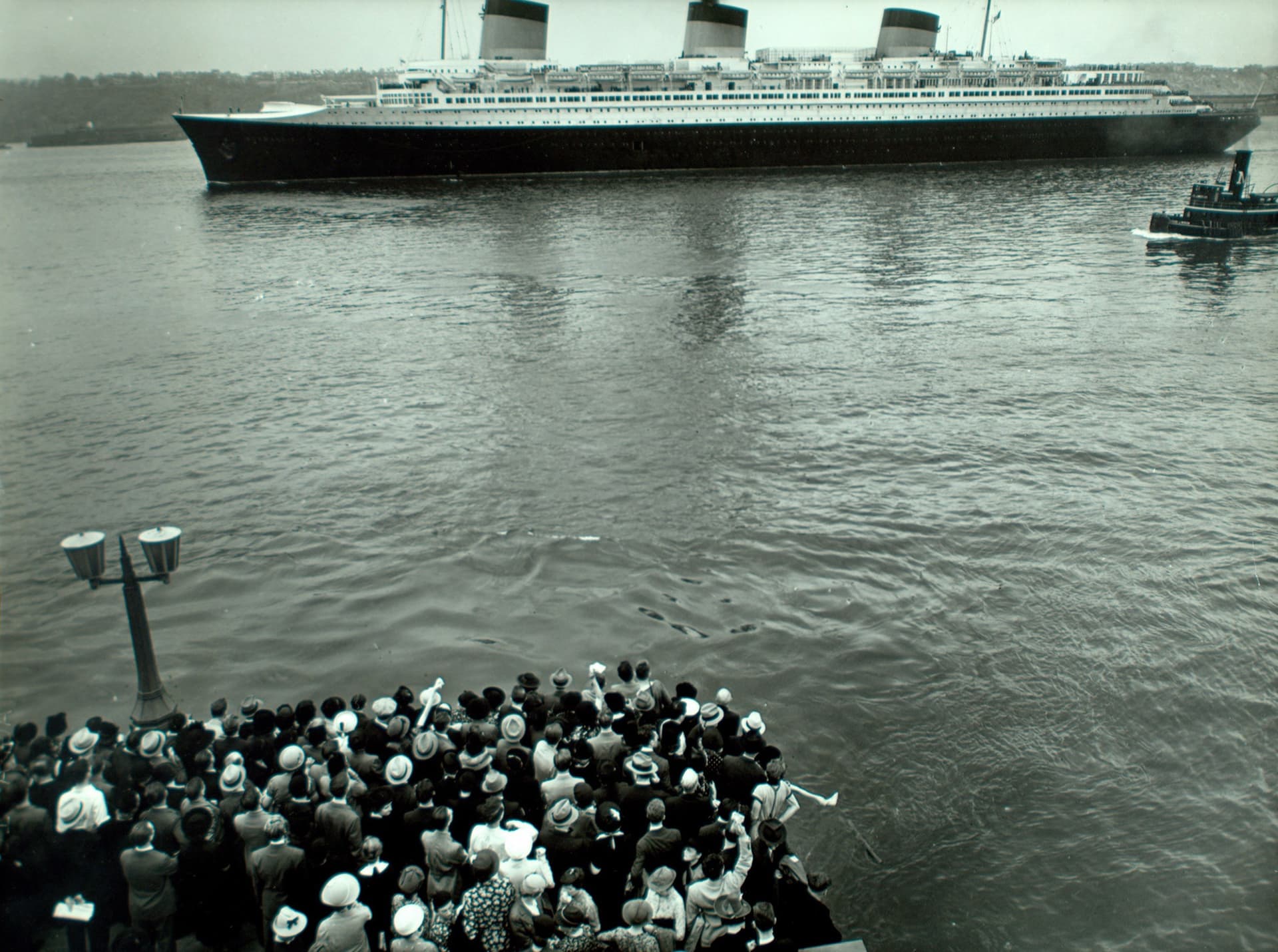
The French Line wanted a flagship to answer Bremen and Europa. Her hull came from Vladimir Yourkevitch, a naval architect of the Imperial Russian Navy who had settled in France after the revolution: a clipper bow, a bulbous forefoot under the waterline, a slim hull. Work began at the Penhoët yard in Saint-Nazaire in January 1931.
She left Le Havre on her maiden voyage on 29 May 1935 and reached New York in four days, three hours and two minutes, at just under thirty knots. The Blue Riband passed from Rex to her. The French had never held it before.
Inside, she was the high point of French Art Deco; her first-class dining room was the largest room afloat. It was also her weakness. Most of her space went to first class, and the travellers of the late 1930s, many of them tourists who could not afford it, preferred the Queen Mary.
She was in New York when the war began in September 1939, and she stayed, tied up at Pier 88 on the Hudson. In December 1941 the United States took her over, renamed her Lafayette and began turning her into a troopship. On 9 February 1942 sparks from a welding torch set fire to a pile of kapok life vests in the first-class lounge. The water poured in to fight the fire gave her a list, and at 2:45 the next morning she rolled over onto her side at the pier.
She was raised at great cost, but restoring her was judged too expensive, and scrapping began in October 1946. Berenice Abbott took the photograph above from Pier 88 on 14 September 1938, a year before the war: the same pier where she would end.
The registry
Compagnie Générale Transatlantique Penhoët, Saint-Nazaire Maiden voyage 29 May 1935 Blue Riband 1935, from Rex Capsized at Pier 88, 10 February 1942
Sources
Secondary sources only, read against each other. Where they disagree the text leaves the detail out and the registry says so.
Next story